Test Data Management 2026: Building Reliable Test Environments at Scale
Release cycles are getting faster. Architectures are getting more distributed. Regulations are getting stricter.
Yet most teams still struggle with a very fundamental problem:
“Our test environments don’t behave like production.”
Flaky tests, missing records, broken dependencies and outdated data all point to the same root cause: test data management hasn’t kept up with how we build software in 2026.
At Gen Z Solutions, we see this pattern across fintech, SaaS, healthcare, and high-growth startups. The teams that win are not just automating more tests — they are treating test data as a product.
This blog will walk through how to build reliable test environments at scale with modern test data management.
What Is Test Data Management in 2026 (and Why It’s Different Now)?
Traditionally, test data management (TDM) meant:
· Taking a copy of production
· Masking a few fields
· Handing it over to QA before major releases
That’s no longer enough.
In 2026, test data management is an ongoing capability, not a one-time activity. It covers:
-
How you create, mask and generate test data
-
How you provision data consistently across environments (API, UI, mobile, microservices)
-
How you keep data in sync with schema changes
-
How you stay compliant with data privacy regulations in non-production
Modern TDM sits at the intersection of:
· QA & test automation
· DevOps & CI/CD
· Security, compliance and data governance
Done well, it becomes a quality multiplier: every test environment becomes trustworthy instead of “best effort”.
What Goes Wrong When Test Data Management Is an Afterthought?
Before fixing TDM, it helps to name the pain clearly. Most teams we talk to face some or all of these symptoms:
1. Flaky Tests and Unreliable Pipelines
-
Tests pass once, then fail the next run
-
Data assumptions are hidden inside test code (“this user id exists”, “this account is active”)
-
CI/CD pipelines spend more time failing due to data issues, not code defects
The result: engineers stop trusting automation and fall back to manual checks.
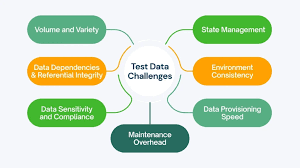
2. Inconsistent Environments
-
QA, UAT, performance and staging environments all have different data realities
-
Collaborating across teams becomes difficult because scenarios can’t be reliably reproduced
-
Bugs “disappear” when moved between environments because the data doesn’t match
Without consistent test data, it’s impossible to know if failures are genuine or environment noise.
3. Compliance and Privacy Risks in Non-Prod
· Raw production data gets cloned into non-production
· Sensitive PII/financial/health data sits in lower environments with weaker controls
· Audits become stressful; it’s hard to prove how test data is handled
For regulated industries, poor TDM is not just a quality risk — it’s a business and legal risk.
Core Principles of Test Data Management for Reliable Environments
When Gen Z Solutions designs a TDM strategy for clients, we anchor it on a few core principles.
1. Representative, Not Random
Test data should reflect real-world use:
· Typical customer profiles
· Edge cases (very large values, nulls, rare combinations)
· Regulatory scenarios (KYC, failed payments, chargebacks)
Your data sets should be intentionally designed, not accidentally assembled.
2. Consistent Across Environments
The same test scenario should behave the same way in:
· Developer sandboxes
· Shared QA/UAT environments
· Pre-production environments used for performance testing
That doesn’t mean copying everything everywhere — it means using repeatable subsets and generation rules.
3. Secure by Design
Non-production data must:
· Mask or tokenize all sensitive fields (names, addresses, account numbers, identifiers)
· Follow the same privacy principles as production
· Be traceable — you should know where data came from and how it was transformed
Security is built into TDM, not bolted on at the end.
4. Self-Service and On-Demand
Teams shouldn’t open tickets to “get some data” and wait days.
Modern TDM enables:
· Self-service portals or APIs to request data sets
· On-demand snapshot and refresh of environments
· Automated population of data as part of CI/CD pipelines
The more self-service you make test data, the less friction you add to your delivery pipeline.
How to Build a Test Data Management Strategy for 2026
Here’s a practical, staged approach we use with clients.
Step 1 – Map Your Critical Test Journeys
Start with the business flows that matter most:
· Revenue-critical journeys (signup → payment → renewal)
· Risk-sensitive journeys (KYC, loan approval, policy issuance)
· Operationally heavy journeys (batch processing, settlements)
Document:
· What entities are involved (users, accounts, orders, transactions)
· What data conditions are needed for each step
· Which environments rely on these journeys today
This becomes your TDM requirements map.
Step 2 – Classify and Protect Sensitive Data
Work with security/compliance teams to:
· Classify fields: PII, financial, health, internal-only, public
· Define masking rules (e.g., tokenization, partial masking, synthetic replacement)
· Agree on which environments can have partially masked vs fully synthetic data
Then implement consistent masking so the same rules apply everywhere.
Step 3 – Choose Your Test Data Patterns
Most robust setups combine multiple patterns:
-
Subsetting: Pull a statistically relevant slice of production, not the whole database
-
Masking: Obfuscate sensitive fields while preserving format and relationships
-
Synthetic data: Generate data for rare or sensitive scenarios that shouldn’t be exposed at all
-
Golden datasets: Small, highly curated data sets for critical regression scenarios
Your mix should match:
· Regulatory constraints
· System complexity
· Test volume needs (API load vs UI smoke vs performance)
Step 4 – Integrate TDM into CI/CD
TDM isn’t real until it’s wired into pipelines.
Examples:
-
Before running a regression suite, refresh environment with a versioned data snapshot
-
For every feature branch, spin up an ephemeral test environment with its own data slice
-
Use pipeline steps to seed test users, orders, contracts via APIs instead of manual SQL scripts
Now your test data becomes predictable, repeatable and auditable.
Step 5 – Monitor, Iterate and Govern
As systems evolve, so should your TDM.
-
Track metrics: environment stability, test flakiness due to data, time to provision data
-
Run periodic test data audits: masking coverage, stale data, broken relations
-
Establish a simple governance model: who owns TDM, who can change rules, how new systems are onboarded
In mature teams, TDM becomes part of quality engineering, not just “something QA does”.
Practical Techniques to Improve Test Data Management Today
Here are some specific moves we often implement for clients:
-
Replace hard-coded IDs in tests with data contracts (e.g., “any active user with one failed payment”)
-
Maintain versioned test data packs alongside code in source control
-
Use factories/builders in automated tests to generate scenario-specific data on the fly
-
Create a shared test data catalog: documented datasets, their purpose, and how to request them
-
Introduce data refresh cadences (daily/weekly) instead of one-off copies before big releases
Each of these reduces the gap between “how tests assume the world is” and “how the environment actually looks”.
FAQs: Test Data Management and Reliable Test Environments
1. What exactly is test data management in QA?
Test data management is the end-to-end process of designing, creating, protecting and provisioning test data across non-production environments so that tests are reliable, compliant and representative of real-world use.
2. Why are our tests so flaky even though we have a lot of automation?
In many teams, automation fails not because of bad scripts, but because test data is inconsistent or incomplete. When environments don’t have the right records, or when data keeps changing under tests, you get false failures and unstable pipelines.
3. How can we handle sensitive customer data in test environments?
The safest approach is to combine masking and synthetic data:
· Use automated masking to obfuscate any PII or sensitive fields
· Replace especially sensitive segments with fully synthetic data
· Apply the same rules consistently across all lower environments
This allows you to keep realistic behavior without exposing real identities.
4. Do we need a dedicated TDM tool to get started?
A specialized tool helps at scale, but you can start with:
· Clear masking rules
· Database subsetting scripts
· Test data packs stored in source control
· Simple APIs or scripts to seed data into environments
As complexity grows, platforms for TDM and environment management add a lot of value — this is often where Gen Z Solutions steps in as a consulting and implementation partner.
5. How does Gen Z Solutions help with test data management?
We typically:
-
Run a TDM and environment health assessment across your QA landscape
-
Design a test data architecture that fits your systems, regulations and roadmap
-
Implement masking, synthetic data and CI/CD integration using tools you already own (or recommend new ones where needed)
-
Establish governance, dashboards and playbooks so your teams can run TDM sustainably
The outcome: fewer false failures, more stable pipelines and test environments you can finally trust.